French Title: Ugly, Dirty and Bad
Year: 1976
Country: Italie - Comédie dramatique - 1:55 a.m.
Réalisation: Ettore Scola
Scénario: Ettore Scola, Sergio Citti, Ruggero Maccari.
Photographie: Dario Di Palma.
Musique: Armando Trovajoli.
Production: Romano Dandi, Carlo Ponti.
Interprètes: Nino Manfredi (Giacinto Mazzatella), Francesco
Anniballi (Domitian), Maria Bosco (Gaetana)
Giselda Castrini (Lisette), Alfredo d'Ippolito (Pliny), Giancarlo Fanelli
(Paris), Marina Fasoli (Maria Free), Ettore Garofolo
(Camillo), Marco Marsili
(Mark), Franco Merli (Fernando), Linda Moretti (Matilde), Luciano Pagliuca (Romulus), Giuseppe
(Tato), John


Ugly, Dirty and Bad (Brutti Sporchi Cattiva e) is "a sight gag where the unbridled delirium leads to the more sober social observation "Archive The World in 1976, Jacques Siclier.
Ettore Scola , which was often screenwriter Dino Risi
, turned a dozen films since 1964 . We knew that Drama of Jealousy (1970 ) when this year We both loved revealed the director virtually unknown 45 years and gave him his image.
renewed Italian comedy by historical realism, the chronic psychological and praise cinephilia (references to
Anto
(Brutti Sporchi Cattiva e)
It is always tempting to define a filmmaker with one successful film, made in its genre, and everyone liked it. Ettore Scola with it is not hasty consecration, but a misunderstanding led at home by We both loved , whose tenderness for the characters and the delicacy of touch not found in Ugly, Dirty and Bad , black humor comedy set in a Roman slum. What Scola, leftist, given to see the poor, victims of the capitalist system, which are neither beautiful nor clean, neither good nor virtuous, nor aware of the class struggle, that's good enough to disconcert the intellectuals Cannes and Paris who contemplate political cinema in terms of an idealization of the proletariat! We must dispel this misunderstanding. THE "POOR POOR" First, have reservations. We are in Italy, near Rome, and the poor of Ettore Scola, migrants from the South Italian, Apulia and Sicily, living more or less lawful activities or performing low-paying jobs few, belong in Indeed, a sub-proletariat folded in on itself. Giacinto (
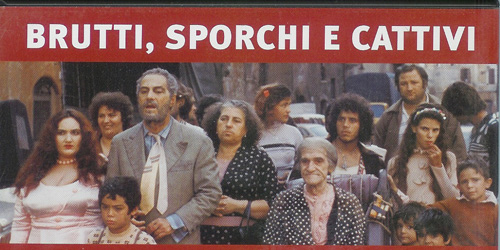
This order of misery is hollow, that's plenty. There was no running water, but it was television, it sells, barters it, we fight for a "legacy" to try to poison the patriarch who refuses to give in his lifetime. It operates the same old unproductive (retired grandmother).
Ettore Scola , they were already in Les Miserables, Victor Hugo of
. But as Scola does not employ lyricism Hugo's, nor the Brechtian distancing, or pauperism same aesthetic Pasolini (Accatone) or pity desperate
The audacity and strength of the film Ettore Scola , this huge farce charged huge effects, cruel and disturbing scenes in comedy development, c is to break the wart, in a show where the crazy gag unbridled results in the most lucid social observation (the awakening of the slum, just to name a few).
The staging is full of ideas, and Nino Manfredi
, great superstar, defends his "loot" against all the tricks and all packages, as a notable citizen its safe. Suburban king of hell, he plays with his, Shakespeare the slum, and as he has no manners, there is gastric lavage with water polluted with a bicycle pump to regurgitate poisoned spaghetti. Style

the sarcastic knows also when he shows no affection of children being locked up for the day in an enclosure Mesh school playground, when he shows the innocence of a dirty girl who finds herself pregnant at the end of the film. He also paints the misery of these uprooted cultural scene in the choir of the poor trying his hand at singing in dialect, and a glass of wine, the chorus of freedom
Trailer VO Drama / Action Duration: 1:34
Director: Francis Ford Coppola
Starring: Matt Dillon
(father), Diana Scarwid  (Cassandra) ...
Francis Ford Coppola
Conversation" and "Apocalypse Now " not at present in place that he deserves in Hollywood. If the most famous Italian-American filmmakers called Ford is that he was born in Detroit, the capital of the automotive industry. His father, Carmine, is a conductor, and his family accompanied him on his constant travel. In 1949, Francis, 10, suffered a polio epidemic. Paralyzed, he must keep his room for nearly a year and deals with puppets. Adolescent, young Coppola replaces the puppets by humans: it runs in 8 mm films to which he added a soundtrack recorded on tape.
student he was spotted by Roger Corman
, producer of B movies and a great talent scout. Corman finance his first feature film, Dementia 13
Big Boy (1967), a touching tale of learning, then finds himself a prisoner of the studio system, flying
The Valley of Happiness (1968), a musical with Fred Astaire . His next film,
The Rain People portrait of a wife dissatisfied any plate that is a road movie gripping.
then, a production company to help Scorsese or Lucas : this generation of filmmakers who want to escape the straitjacket Hollywood. From this period, Coppola
connects the masterpieces: Conversation, which flows in the climate of paranoia of Watergate, The Godfather
his masterful adaptation of Mario Puzo's novel
Apocalypse Now. Drugged, gnawed with anguish, he dives at the "heart of darkness" as the hero of the short novel by Joseph Conrad he transposes during the Vietnam War. The film is extraordinary, but Coppola defeated by fate: the producers turn their backs. He feels then all types - the chronicle teenager ( Outsiders, Rusty James), the fresco of time (
Cotton Club, 1984), comedy (
Peggy Sue Got Married, 1986) - and even returned to the war Vietnam ( Gardens of Stone, 1987). During the latter film, Coppola
Tetro.
 comes at a critical moment in the career of Francis Ford Coppola
  The Godfather (1972) - the 1980 will be those difficulties and disappointments. The exorbitant cost of
 Apocalypse Now (1979) and the failure of Favorite
(1982) condemned
Coppola on a budget.
He chose to adapt quick succession of two books
Susan E. Hinton, a novelist popular especially among teenagers. Outsiders and
Rusty James are both shot in Oklahoma, with young Matt Dillon
and Diane Lane
. The first is a melodrama in color very accessible, as a demonstration of know-how for the studios, the second in black and white in a bold style that borrows from German expressionism, is an "art film and testing for teens," according to a formula of the filmmaker.
The Rusty James title (Matt Dillon
) is sixteen years old and lives on the margins of society, between an alcoholic father (Dennis Hopper
) and his small band of delinquent friends. He lives in worship of his brother, "the motorcycle boy (Mickey Rourke
), which comes just in time for a trip to California to help Rusty and try to build him a semblance of relationship . Both characters are part of a genealogy cinephile: Rusty looks furiously
Coppola revisits the familiar territory of American cinema in its own way: with a constant inventiveness. The film is shot in black and white, but allows himself a few spots of color to film the fish's brother Rusty would free them from their jar: they are blue and red, like the American flag. The sets are drowned in mist and shadows were painted on walls by Dean Tavoularis, collaborator with
Coppola, as at the time of
Rusty James is not a mere exercise in style. By its central motif - the relationship between the brothers and their father - the film coincides with the major obsession of Coppola: the family microcosm, whose gang is a substitute here. Florence Colombani - The World
 Trailer VO: Rumble Fish Inge Landgut (Elsie Beckmann), Otto Wernicke (Inspector Karl Lohmann) ... Screenplay: Fritz Lang and Thea von Harbou , according to an article by Egon Jacobson Photo: Fritz Arno Wagner
 Sets: Edgar G. Ulmer Production: Nero Movies
Fritz Lang speaks of "M le Maudit" In an interview with Cahiers du Cinema ", published in 1966, the director explains that he appealed to "twelve or fourteen off-the-law "To shoot the scene of Judgement
After the great frescoes Nibelungen, Metropolis and Woman on the moon, I'm more interested in human beings , the motives for their actions. Contrary to what many people believe,
M le Maudit was not from the life of the infamous assassin Düsseldorf, Peter Kürt . It turns out that he had just started his series of murders while Thea von Harbou and I were writing the screenplay
. The script
was completed well before it was taken.
 In fact, the first idea what the movie
 M
the of Berlin (at Alexanderplatz ), and had access to certain files whose content was quite confidential. There were reports of numerous murderers as
Grossman of Berlin the terrible ogre Hanover (who killed so many young people) and other like-minded criminals.
For the trial in M I received some unexpected help from an organization of criminals among whom I had made friends at the beginning of my research for the film. In fact, I really used twelve or fourteen of these off-the-law, who were not afraid to appear in front of my camera because they had already been photographed by police. MY FIRST FILM TALKING Others would have liked me, but they could not do so because they were not known to the criminal brigade. I was about to finish filming the scenes were so real criminals when I was informed that the police arrived. I told my friends, but asking them to stay for the last two scenes. They all agreed and I turned very quickly. When police arrived, my scenes were in the box and my "actors" had all disappeared
If I had been associated with a producer, I could never make this film. What producer would have liked a movie without a love story where the hero is a child killer? As M was my first talkie, I experimented with sound, which was obviously not possible in the silent cinema. Remember the blind beggar who goes Bazaar beggars to rent an organ at hand: when he plays a song, a few wrong notes face his hearing, he suddenly put his hands over his ears not to hear these discordant sounds and at the same time, the music stops in the film. There are other times when I used sound: not in the eerie silence of a street at night, or the heavy breathing of the child killer.
But, as the sound can add depth to a scene, the deliberate killing of an action may increase the dramatic content. Let me explain ... When the child is killed, his little ball rolling out of a bush and finally stops. The audience identified with the girl and from this, by association, he knows that with the ball movement, the life of the little girl was also arrested.
I could not, of course, horrible show that child sexual abuse, but not showing the action, I got more feedback from the public that if I really showed the scene detail. I force the viewer to use his own imagination.
A KIND OF psychoanalyst
[...]

 I have often said that a director, working with actors, would be a kind of psychoanalyst, not for the actors themselves, of course, but for the characters. They exist primarily on paper, the director must make them live for the actor, then to the public.
 One day at
Hollywood, a writer said:
"I know exactly what you thought when you were filming this scene M , and I told him
" Say it. " He charged his theory at length and it was completely false. At least I thought at the time, but years later, when I was in full press conference in Paris
and I was telling this story, I stopped short because I ' I realized that there could be a profound truth in this kind of thing ... what we call "touch" of a director came from his subconscious - and himself is unconscious when he made his film ... Gretchen Weinberg
A confession of Fritz Lang's "Cahiers du Cinema", published in June 1966
The Author in Majesty
As
Griffith, Murnau and others, Fritz Lang
in 1927, came to embody the author in all his majesty (and to play this role in Contempt
directed by Jean-Luc Godard in 1963). During his career Europeanof 1919 with
The Master of Love in 1934 with Liliom, Lang exercises absolute control over the production of his films. A Hollywood (
Fritz Lang was born in Vienna in 1890 in the upper middle class Catholic (his mother, Jewish, had converted). Tempted by the painting, he discovered, to
1926. shadows hanging over the Cursed M announce the future Now the Germany. More broadly, they reflect a conception of man based on the death instinct. "
The desire to hurt, the desire to kill," he wrote, are closely related to sexual need, under the rule which no man acts wisely. "Death," the greatest drama
"which"  always has the last word "haunts all his work, the sublime black films (La Femme
the portrait in 1944
The Secret behind the door in 1948) at masterpiece about childhood disguised in adventure movie (The smugglers of Moonfleet in
1955). He died in1976, sixteen years after a final
Mabuse, leaving an immense work. " Lang, who lived with such intensity, do not be reduced - he and his films - to a common denominator
" wroteLotte Eisner .
Florence Colombani
Rule The World in the edition of 03.10.2004
 M or the Spirit of the Letter
M . Amazing cinégénie this centrality of the alphabet is at the center of the screen when the killer discovers girls in a mirror the stigma which refers to public vengeance. There is little way, indeed, to differentiate the M
capital of its reflection.The letter and its dual illustrate a principle of reversibility with the assertion, repeated throughout the film continues to fascinate and disturb the viewer of the twenty-first century. Flattening of all poles, loss of points Landmark: Speaking of the first game Fritz Lang is one of those rare masterpieces that the consecration will never erode the subversive power. When so many other films are processing, M proclaims, as his hero psychopath, I is another. How to say in radicalizing the model of romantic Stevenson ( that Lang will that adapting throughout his career), that is Dr. Jekyll Mr. Hyde . We must therefore return to the character of Hans Beckert , hallucinatory creature played by Peter Lorre
an ecstatic and hear him declare his judges sitting in a dazzling self-analysis: " I feel that someone is following me through the streets. It is the one that haunts me. And sometimes I feel I continue myself. "Therefore, the guilt of the killer of children has more than matched by his irresponsibility unbearable. His rhetorical question "Is can I do otherwise? "refers to the idea of an ancient curse that the French translation of the title, however, excessively talkative, see accurately. Lang's strength is precisely not to retract the scandal and confusion that raises this point of view. The filmmaker gives the floor to the most radical advocates of repressive policies and leaves irony about the innocence of a criminal condemned them long before the charade of the trial.
COURT OF CRIMINAL AND VAGABOND "
She is good! So we're told that irresponsible and cajole you into a nursing home! Can you escape or there will be an amnesty. And you, relaxed, you have nothing to fear: you're irresponsible. You still zigouilleras girls! Speech universally known that the proponents of the death penalty, with which the filmmaker keeps his distance. It is a court of beggars and criminals - chaired by a gang leader whose blond, the leather coat and the cold brutality emerge before the time the Nazi archetype - whose resolutions call for the execution eugenicists " It must be exterminated. It must be eliminated.  "terrifying Terms under History. Let us, however, to conclude the superiority of justice over that of regular mob. The trial underground is probably that the metaphor of the regular trial. The outcome of the latter, which Lang pretends to ignore, is unlikely to be different for the accused. Ordinary citizens have they not shown the first few minutes of film of a taste for the lynching that does not deny the fauna of the Unterwelt ? How, moreover, should not be interpreted in the same direction parallel to the pursuit of law-breakers and police? And that is the ultimate victory of well-organized bandits taking speed the authorities in their hunt for the criminal? Tion to the Commissioner that he wants to confess. The burglar caught in the act is similar to a "newborn". The murderer was formally recognized by the blind. That's a world where meeting real culprits and fake innocent looming. The demonstrative power of the coupling noise drives the point home: a sentence that began with a police officer may be terminated by a villain. The very genre of film is contaminated by the widespread confusion. The proliferation of written documents - newspapers, posters, letters - and the minute description of indices and methods of investigation by abolishing the border between documentary and fiction. Subsists while the hyperbolic doubt and violently pessimistic of a filmmaker who does not hesitate to get involved in skepticism. No one has forgotten the haunting song Solveig , alleging
Peer Gynt, Grieg of which serves as leitmotif for the offense appearances. At the inability of Peter Lorre whistling the famous saw Fritz Lang chooses, it is said, to interpret himself haunting melody of the killer. And become, forever, the lining of M . Thierry Méranger - The World
Preview: M the Cursed (1931) Fritz Lang (Duration: 3 min 11 sec)
http://7-art.blogspot.com


 Several tracks allow the viewer to walk through the seasons of
 "Spring, Summer, Fall, Winter ... and spring, "the filmmaker Korean director Kim Ki-duk, is a fable about learning liturgical spiritual tranquility between Buddhist and materialistic temptations